

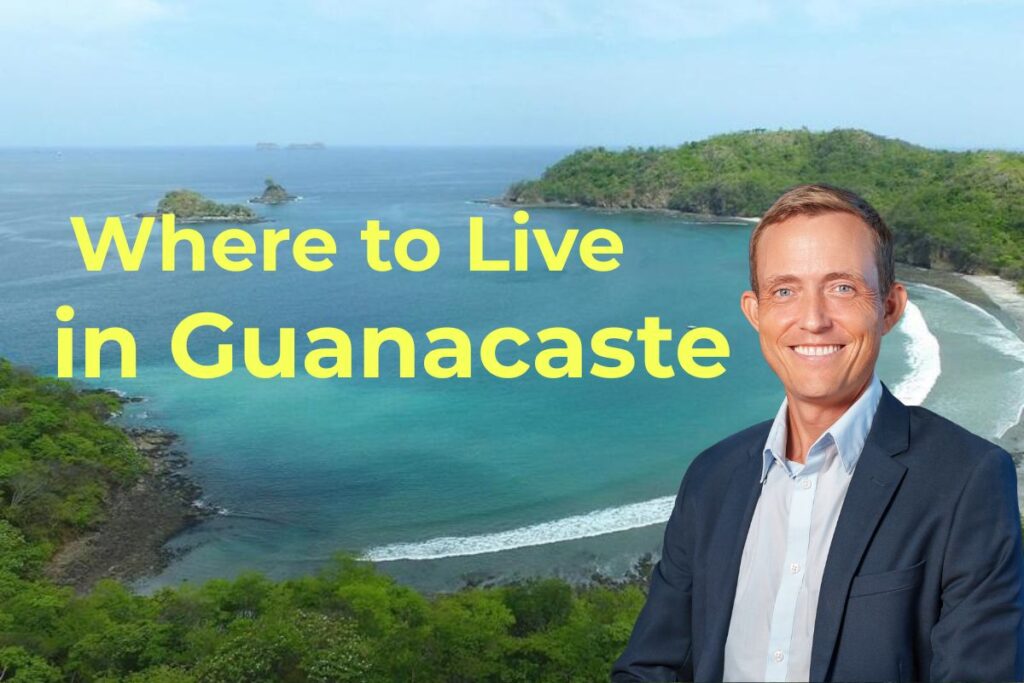
I get some version of where to live in Guanacaste questions almost every week, usually before a client has even booked their flight. They’ve watched a few YouTube videos, scrolled through listings, and now they want a straight answer: where should I actually buy in Guanacaste?
Here’s the honest answer, after 15+ years living here and helping clients close deals since 2012: there isn’t a “best” town. There’s a best fit. Tamarindo, Flamingo, Junquillal, Avellanas — every one of these places has buyers who are thrilled with their decision and buyers who would have been miserable there. My job isn’t to sell you on my favorite beach. It’s to figure out which one is actually yours.
I’ve lived in Guanacaste since 2008, when I first came down as a Peace Corps volunteer. After my service, I stayed on to direct an environmental nonprofit, Restoring Our Watershed, and I’m still President of the Board of the Nandamojo Watershed Protection Association today. I mention that not to pad a bio, but because it matters: I’m not a fly-in agent who learned the market from a spreadsheet. I’ve built community organizations here, raised the trust issues that come with foreign land ownership, and watched these towns grow from the inside for close to two decades. Since founding Coldwell Banker Pacific Realty with my partner Larry Graziano in 2022 — after four years with Coldwell Banker Tamarindo Realty and a stretch running my own brokerage, Latitude 10 Realty, with my wife Ann Marie — I’ve represented buyers and sellers across every one of the areas below.
So before I break down the towns, I want to deal with the biggest mistake I see buyers make.
The Biggest Mistake Buyers Make Before They Even Talk to Me
Everyone visiting Guanacaste seems to know somebody, or knows somebody who knows somebody, who “has a great deal” on a property. A bartender’s cousin. A guy at the surf shop. A friend of a friend on a Facebook group. The pitch is always the same: a great price, inside information, don’t miss out.
This is where buyers get into real trouble. Not just with location, but with true property value. Someone without local licensing, legal training, or accountability can hand you a price that has nothing to do with what the property is actually worth, or steer you toward land with title issues, water rights problems, or zoning restrictions you won’t discover until it’s too late. Buying property in Guanacaste, Costa Rica, a country where U.S. law doesn’t apply is already a legitimate source of anxiety for most of my clients. Handing that process to an unlicensed “connection” instead of a broker who’s accountable to a brand and a professional association multiplies the risk. As one client, Jim Schutte, put it after working with me: buying in a foreign country where U.S. laws don’t apply can be scary, but a good broker steers you through it seamlessly.
That’s the filter I’d encourage you to apply to any advice you get about Guanacaste, including mine: is this person actually accountable for the outcome, or just passing along a tip?
With that out of the way, let’s get into where you should actually be looking.
Tamarindo: For Buyers Who Want to Be in the Middle of It
Who Tamarindo Is Really For
Tamarindo is Guanacaste’s commercial and rental epicenter, and it earns that reputation honestly. If you want to walk to restaurants, bars, and the beach, rent a boat for deep-sea fishing on a whim, and be surrounded by a large, established, English-speaking expat community, this is the town. It’s also the area with the highest tourist numbers on this coast, which is exactly what some buyers want and exactly what sends others looking elsewhere. Neither reaction is wrong — it just tells you something about what you actually want your daily life to look like.
What It Costs
Values in Tamarindo run roughly $3,300 to $4,561 per square meter depending on proximity to the sand. In practical terms:
- Entry-level, under $400K: studios and older 1–2 bedroom condos within walking distance of town — a high-demand segment.
- Mid-range, $400K–$800K: 3-bedroom single-family homes and premium condos. This segment is currently in a buyer’s market correction, with motivated sellers who bought at the peak now pricing more realistically.
- Luxury, $1M–$9.7M+: gated communities like Senderos and ocean-view estates in Playa Langosta. Ocean-view inventory is moving, but only when it’s priced realistically.
What Day-to-Day Life Looks Like
Tamarindo is about an hour from Liberia airport on fully paved roads — a sedan is fine, no 4×4 required. It’s the only town on this list with true commercial infrastructure: Auto Mercado (well-stocked with North American imports), multiple domestic supermarkets, boutique shops, and walk-in medical clinics. For anything serious, you’re still looking at an hour to Liberia’s hospitals. Internet is the most reliable on the coast, with multiple redundant commercial providers — genuinely good for remote work. Families also have access to international private academies like CRIA and La Paz, which matters if schooling is part of your decision.
Playa Flamingo, Hacienda Pinilla, and Playa Grande: Guanacaste's Luxury Corridor
Who This Cluster Is Really For
I group these three together because they serve the same buyer: someone looking for a higher-end, more curated property in Guanacaste, whether that’s a golf-front villa, a marina-view condo, or a private estate bordering protected land. Playa Grande fits naturally with Flamingo here, it offers low-density, privacy-focused luxury right on the edge of the national marine park, with prices trending about 10–15% below downtown Tamarindo for comparable space.
What It Costs
- Playa Grande: titled, build-ready lots from $300K to $1.5M; eco-luxury homes from $1M to $4M+.
- Playa Flamingo: ocean-view condos near the new marina from $460K to $700K; premier South Ridge oceanfront estates from $3.6M to $8M.
- Hacienda Pinilla: multi-family townhome-style condos starting around $500K, mid-range family duplex villas around $1.2M, and signature golf or beachfront estates from $4M to $10M+.
Life in the Luxury Corridor
This cluster is built around anchor infrastructure — the Marina Flamingo and the Hacienda Pinilla golf course — which means it’s more master-planned and resort-managed than organic. Gated communities here, particularly Hacienda Pinilla, tend to have the most resilient power and internet infrastructure of any rural area on this coast. If your priority is privacy, amenities, and a more insulated, managed environment, this is where I’d point you.
Playa Avellanas, Playa Junquillal, and Playa Negra: The Quiet, Undiscovered Coast
Who Belongs Here
South of Tamarindo, density drops off fast. Avellanas and Junquillal are, in my honest opinion, still undiscovered — smaller towns roughly 30 minutes from Tamarindo, with quiet beaches and mid-priced opportunities that don’t exist closer to town. I fold Playa Negra in with Junquillal for the same reason: it’s the same profile of buyer looking for surf culture and a low-key, uncrowded lifestyle rather than a scene. This cluster is for buyers who prioritize privacy, world-class surf breaks, larger acreage, and a slower pace over walkability and nightlife.
What It Costs
- Lots and land: interior rustic lots from $50K to $80K; lots in structured gated communities like Tierra Pacífica (Junquillal) or Pochote Hills (Avellanas) from $100K to $300K; larger multi-acre parcels scaling into the multi-millions.
- Single-family and surf villas: turn-key 1–2 bedroom surf cottages from $285K to $350K; standard modern 3-bedroom builds from $450K to $700K.
- Luxury and beachfront: premium eco-villas and true beachfront properties from $750K to $4M+.
The Trade-Offs Nobody Tells You About
This is the cluster where I spend the most time managing expectations, because the lifestyle appeal is real but so are the logistics. Grocery shopping is limited to small corner supers — for a full grocery run, banking, or a real medical checkup, you’re looking at a 20–40 minute drive into Tamarindo from Avellanas, or a drive to Santa Cruz from Junquillal, bypassing Tamarindo entirely. Main roads are paved, but the last stretch into these beaches is often rough dirt, and a high-clearance 4×4 is genuinely recommended, not just a nice-to-have. Internet is stable fiber in most pockets, but because these areas are less dense, outages from storms or fallen limbs can take a little longer to fix than they would in Tamarindo. None of this is a dealbreaker — it’s simply the trade you make for privacy and price. I just don’t think buyers should find it out after closing.
How I Actually Help Clients Choose
I don’t hand people a list of towns and let them guess. I ask questions first, because the honest answer to “where should I live” depends entirely on how you’re going to live. Do you need reliable internet for remote work, or is that irrelevant to you? Are you buying with school-age kids who need access to CRIA or La Paz, or is that not a factor? Do you want to walk to dinner, or do you want nobody within earshot? And critically — are you shopping with a location in mind first, or a lifestyle in mind first, letting the location follow from that?
That last question matters more than people expect. Clients who start with “I want to be in Tamarindo” sometimes end up happier in Avellanas once we talk through what they actually want their mornings to look like. One client, Billie Biven, put it simply after we worked together: I listened to what they wanted and found them the perfect place within their budget — not the place they initially asked about, but the one that actually fit.
A Story That Sums Up Why the Right Location Isn't the Only Thing That Matters
Even the right property in the right town can hit a snag. I had a closing where an unexpected issue came up at the very last minute — the kind of thing that can turn a dream purchase into a stressful mess. One phone call resolved it, and what could have derailed the deal instead became part of the story my client, Shana Maxey, still tells about buying in Guanacaste. That’s the part of “where to buy” that doesn’t show up in a comparison of towns: having someone in your corner who can actually fix a problem when it shows up, not just point you toward a nice beach.
So, Where Should You Actually Buy in Guanacaste?
If you want energy, walkability, and the coast’s biggest expat community, look at Tamarindo. If you want a more curated, higher-end, master-planned lifestyle with golf or marina access, look at Flamingo, Hacienda Pinilla, or Playa Grande. If you want privacy, surf, and a quieter pace at a lower price point — and you’re willing to drive for groceries — look at Avellanas, Junquillal, or Playa Negra.
But the town is only half the answer. The other half is you: how you work, whether you’re raising kids here, how much quiet you actually want once the novelty wears off. That’s the conversation worth having before you fall in love with a listing.
If you want to see what’s actually available in the area that fits you, sign up for my Guanacaste Real Estate Listing Alerts and I’ll send you new and pocket listings as they come to market, matched to what you’re actually looking for.