

#1 Flaw in Guanacaste Homes (And How to Spot It)
Costa Rica Matt was recently walking through a home with one of his clients, Christy. The listing was priced somewhere north of $800,000. Maybe even over a million. A big, beautiful home in a great location. The moment they stepped inside, Matt did what he always does. He tapped on the wall. Then he turned to Christy and frowned.
“For that price tag,” he told her, “one would expect a higher construction quality.”
That’s the whole story in one moment. Before Matt looks at the finishes, the pool, or the ocean view, he taps the walls. After years of walking through homes across Guanacaste, he’s found that a few taps tell him more about a home’s long-term durability than almost anything else he can check in the first five minutes.
The Tap Test: Matt’s First Move Inside Every Home
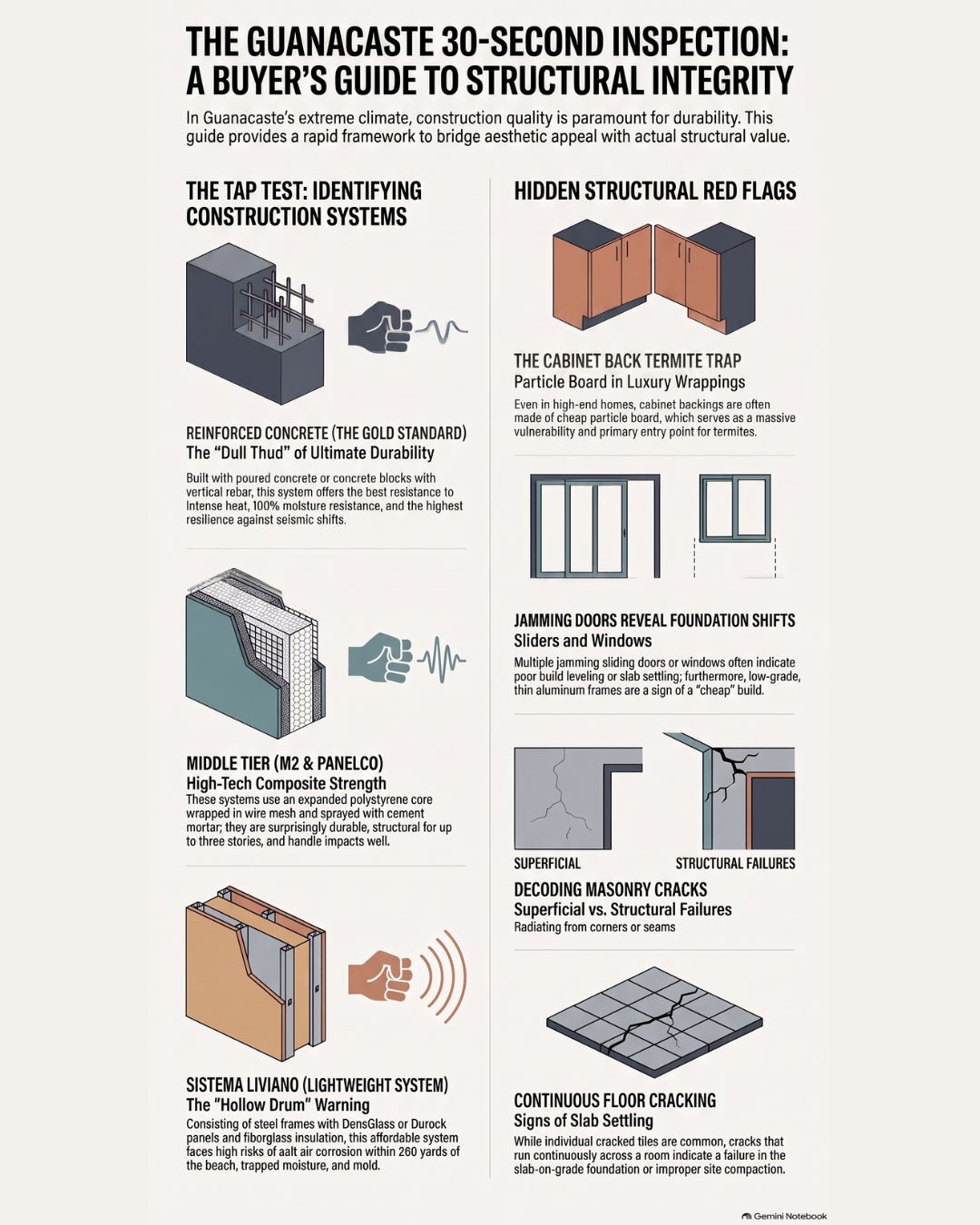
It sounds simple, and it is. But that’s part of why it works so well. What you hear and feel when you tap a wall tells you which construction system was used to build the home. And in Guanacaste, that system is one of the biggest factors in how well a house holds up over time. There are three main systems you’ll run into here. Each one sounds and feels different under your knuckles.
The Three Construction Systems You'll Find in Guanacaste
Reinforced Concrete
This is the gold standard. Reinforced concrete homes are built with either poured concrete walls, or more commonly, concrete block with rebar running vertically through the cores. Tap it and you’ll hear a dull thud. It feels dense and heavy. There’s no mistaking that you’re knocking on real mass. This is the benchmark for durability in this climate. Nothing else commonly used in the region holds up as well over the long run.
M2 (Emmedue) and Panelco
These are the two major providers in the middle tier. Both use a similar approach: an expanded polystyrene core, wrapped in wire mesh, with a cement-based mortar sprayed over the mesh to form the finished wall. Panelco is actually a structural system on its own. Builders can put up two or three story homes using it as the main structural element, and the durability comes surprisingly close to concrete. Tap one of these walls and the sound is a bit higher pitched than concrete, with a lighter feel. It’s a step down in density, but still a long way from hollow. It’s a legitimate, capable system. It just isn’t in the same durability class as reinforced concrete over the long term.
Sistema Liviano
This is steel stud framing, usually finished with DensGlass or Durock panels, which are a cement and fiberglass composite board, with insulation packed between the studs. Tap this wall and you’ll notice it right away. The sound is light and hollow, closer to knocking on a drum head than a solid door. You can tell almost instantly that you’re up against something built mostly out of air, not mass.
Why This Matters More in Guanacaste Than Almost Anywhere Else
In a milder climate, the gap between these three systems might not matter as much. Here, it’s a different story. Sistema Liviano homes near the shoreline take the biggest hit. Matt has seen steel studs corrode over time from coastal humidity and salt air. Because the wall cavity is full of insulation instead of solid mass, even a small leak can cause outsized damage. Moisture gets trapped, mold sets in, and the insulation holds water against the steel long after the surface looks dry. Compared to reinforced concrete, a lighter system is more exposed to nearly everything Guanacaste’s climate throws at a house, including:
- Humidity and general moisture intrusion
- Salt air corrosion near the coast
- Termite access
- UV and heat degradation of certain materials
- Water infiltration during heavy rainy season storms
- Wind and structural stress
Reinforced concrete simply doesn’t have most of these failure points to begin with. That’s the real reason the tap test matters so much here. Guanacaste’s climate doesn’t forgive a lightweight wall.
Can You Do the Tap Test Yourself?
Yes. Anyone can knock on a wall during a showing and notice the difference between a thud and a hollow, drum like sound.
But here’s the part that actually matters. The test itself is easy. Knowing what it means is not. But here’s the part that actually matters. The test itself is easy. Knowing what it means is not.
Matt has walked through enough homes, in enough communities, across enough price points, to know instantly what a tap is telling him and what to ask next. A first time buyer might notice that something sounds different. Matt knows exactly what that difference means, what it’s likely to cost down the road, and whether it’s a dealbreaker or just something to factor into an offer.
That gap between noticing and understanding is what years of experience actually buys you. It’s the same thing Matt brings to every client relationship, whether he’s walking a buyer through showings or helping a seller get a home ready for market.
What Usually Happens After a Moment Like Christy's
Christy’s search is still going. Matt is still helping her find the right property in Guanacaste, and that frown was just one data point in a long, careful process.
But that kind of moment is a familiar one for anyone shopping for property here with an experienced local agent. A high price tag doesn’t guarantee a high quality build. Buyers who don’t know what to listen for can end up paying concrete level prices for a Sistema Liviano home without ever realizing it.
When a tap test reveals a mismatch between price and construction quality, it usually leads to one of a few conversations. Sometimes it means negotiating the price down to reflect the home’s actual durability. Sometimes it means bringing in a structural inspector to confirm what the walls are already telling you. And sometimes it simply means moving on to a property that’s actually built to match its price tag.
Construction quality shows up everywhere in Guanacaste, across every community and price point. Matt has represented quality, reinforced concrete builds in sought after areas like Playa Flamingo, which is part of why he walks every property with clients himself rather than relying on listing photos alone. If you want to see how this plays out in a specific market, take a look at our guide to buying in Playa Junquillal.
Why You Need Costa Rica Matt When Buying in Guanacaste
A beautiful listing photo can’t tell you what’s inside the walls. A price tag can’t tell you how a home will hold up after five rainy seasons on the coast. Only an agent who has walked hundreds of homes, tapped hundreds of walls, and watched how each construction system actually performs over time can tell you that before you own it. That’s the value Matt brings to every buyer and seller he works with in Guanacaste. Not just access to listings, but the pattern recognition to know what you’re really buying.
Want to learn more before you start touring homes? Download Matt’s free Guanacaste Real Estate VBook, his video guide covering construction quality, buyer red flags, and everything else worth knowing before you shop for property here.